

 changeadmin
Agriculture plays a vital role in India’s economy, supporting the livelihoods of about 46.1% of the population.
As per the Ministry of Statistics and Programme Implementation, the Gross Value Added (GVA) of the Agriculture and Allied Sector is estimated to reach Rs. 52.08 lakh crore in 2025-26.
Sustaining this vital sector of the Indian economy requires reliable and affordable energy for irrigation and other farming operations. Solar power can help meet these everyday needs while advancing India’s clean energy transition.
India’s vast agricultural land offers significant prospects to integrate solar energy with farming.
According to Land Use Statistics for 2023-24, the country’s reported area covers 306.96 million hectares, of which approximately 55 per cent is agricultural land.
The net sown area stands at 138.99 million hectares, while the gross cropped area covers 217.88 million hectares.
This extensive land base offers opportunities to generate solar electricity alongside agricultural production.
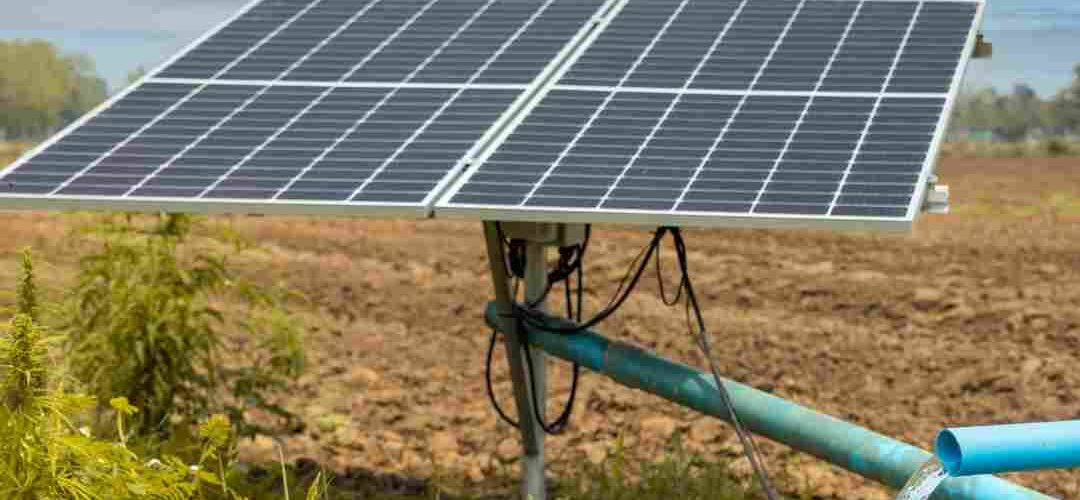
Farmers can use solar power to operate irrigation pumps, reduce dependence on conventional electricity and potentially generate supplementary revenue by supplying surplus electricity to the grid.
For instance, solar-powered irrigation pumps can provide daytime power for watering crops while reducing reliance on diesel-powered alternatives.
Agrivoltaics takes this integration further by bringing together crop cultivation and solar electricity generation on the same land.
Agrivoltaics: Bridging Agriculture and Renewable Energy
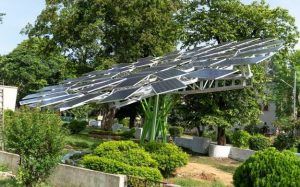
Agrivoltaics, also known as agrisolar or dual-use solar, uses solar panels installed above or between crop rows to generate electricity while continuing farming.
The agrivoltaics system maximises land-use efficiency, provides shade for crops and creates additional benefits for farmers.
Depending on the crop, panel design and local conditions, partial shading may also help reduce soil moisture loss.
This approach can improve land-use efficiency, diversify farm earnings and strengthen both food and energy security.
It offers a promising pathway to align farmers’ livelihoods with India’s wider renewable energy ambitions.
Read more about the design, challenges and benefits of agrivoltaics in our separate article on the subject.
Agrivoltaics in India
Through research, field demonstrations and policy development, India is exploring ways to adapt agrivoltaics to diverse agricultural conditions.
As of August 2025, India had 36 operational agrivoltaics projects with an installed capacity of 37.54 megawatts, alongside 10 pilot projects under development.
These Projects span diverse agroclimatic regions and include elevated structures, interspace layouts and tracking systems, reflecting India’s evolving approach to integrating solar power generation with agricultural production.
India’s Agrivoltaic Potential
Agrivoltaics in India holds significant potential. Estimates place the country’s agrivoltaic potential between 3,000 GW and nearly 14,000 GW, highlighting the scale of opportunity at the intersection of agriculture and renewable energy.
Agrivoltaic systems can also diversify farmers’ income. In some cases, annual earnings could rise from around ₹60,000 per acre to over ₹1 lakh per acre.
Scope for Agrivoltaics Developments
Land Suitability: The GIS-based national screening identified 47.35 million hectares of “restricted cropland” suitable for AgriPV after applying environmental, agronomic, and technical filters, reflecting a conservative, climate-resilient land base.
Crop Compatibility: Fruits, vegetables, spices and medicinal plants offer promising options for cultivation alongside solar installations.
High-potential states include Maharashtra, Rajasthan, Andhra Pradesh, Madhya Pradesh, Karnataka and Uttar Pradesh, which collectively account for nearly 50 per cent of India’s estimated AgriPV power generation potential, driven by a favourable combination of cropland availability, solar resource, and agro-climatic conditions.
In contrast, Odisha, Tamil Nadu, Kerala, Telangana, Bihar, and West Bengal show moderate potential.
The southern, western, and central regions exhibit the most favourable combination of solar irradiance, land availability, and horticultural intensity for large-scale deployment.
Government Initiatives in Agrivoltaics Development
Indian Government has undertaken a range of policy, research, technology development, and implementation measures to advance adoption and expansion of agrivoltaics in India.
Pradhan Mantri Kisan Urja Suraksha evam Utthaan Mahabhiyan (PM KUSUM): Launched in February 2019, the PM KUSUM scheme encourages solar energy adoption in agriculture, reduces dependence on diesel and creates opportunities for farmers to diversify their earnings.
It envisages central financial assistance of approximately ₹34,422 crore. It also enables decentralised solar power generation and solarisation of agricultural pumps, creating avenues for integrating solar energy with farming.
Centre of Excellence on Agrivoltaics: The National Institute of Solar Energy, in collaboration with the Indian Council of Agricultural Research’s Indian Agricultural Research Institute, has established a CoE for agrivoltaics research, demonstration and capacity building.
It has undertaken pilot projects, including a 100-kilowatt agrivoltaic system at the Indian Agricultural Research Institute.
State-specific Initiatives
Several states are facilitating solar energy in agriculture through region-specific schemes.
Mukhyamantri Saur Krushi Vahini Yojana 2.0, Maharashtra: The scheme drives solar power generation through 16,000 megawatts of solar projects across approximately 35,000 acres of government and private land to support electricity supply to agricultural consumers.
Kisan Suryoday Yojana, Gujarat: Expands solar energy utilisation to meet farmers’ electricity needs by providing daytime power supply for agricultural activities, with a planned supply window of up to 16 hours daily, from 5:00 AM to 9:00 PM, through the phased commissioning of solar and other non-conventional energy generation plants.
Surya Raitha Scheme, Karnataka: The scheme advances solar-powered irrigation pumps and allows farmers to earn from surplus electricity. Solar pumps help farmers access energy to water their crops while reducing dependence on diesel-powered pumps.
The Government of India, alongside state governments, is advancing solar energy use in agriculture through policy measures and targeted programmes.
These efforts are expanding the scope and potential of agrivoltaics in India by creating opportunities to co-locate solar power generation and agricultural production.
India Agrivoltaics Alliance
The India Agrivoltaics Alliance (IAA), anchored by the National Solar Energy Federation of India (NSEFI), is a multi-stakeholder platform advancing the dual use of land for solar energy generation and agriculture.
Launched in 2023, the Alliance has grown to over 40 members and works with government ministries and industry stakeholders to advance agrivoltaics through policy advocacy, research and on-the-ground implementation.
It develops knowledge resources, promotes pilot projects and supports scalable business models to improve land productivity, diversify farmer incomes and strengthen rural energy access.
Powering Prosperity Through the Convergence of Farms and Clean Energy
Agrivoltaics in India offers an opportunity to strengthen agricultural livelihoods while advancing environmental sustainability.
By combining food production with renewable energy generation, it can enable more efficient land use, conserve water under suitable conditions, and build greater financial resilience.
The Government of India’s initiatives, including PM-KUSUM and proposed measures to expand agrivoltaics, reflect efforts to connect rural development with clean energy goals.
As implementation grows, locally suitable designs, scientific research and farmer participation will be essential to balance agricultural productivity with energy needs. This approach can contribute to a more resilient and sustainable future for India.





Add comment