

 changeadmin
Catch the Rain is a campaign launched by the Indian government focused on rainwater harvesting, groundwater recharge, and water-body restoration.
The campaign was launched on 22 March 2021, World Water Day, by Indian Prime Minister Narendra Modi with the slogan “Catch the rain, where it falls, when it falls.”
Administered by India’s Ministry of Jal Shakti, the campaign encourages communities and institutions to conserve rainwater and strengthen water security.
The campaign builds on the success of Jal Shakti Abhiyan 2019, which covered 1,592 water-stressed blocks across 256 districts for promoting rainwater harvesting.
The Catch the Rain campaign promotes cleaning ponds and water reservoirs to maximise monsoon water retention. It also encourages afforestation to enhance green coverage in water-retention areas.
It also promoted groundwater recharge, watershed development, rejuvenation of water bodies, and community participation through a Jan Andolan approach.
Key water conservation actions recommended during this campaign are:
- Adopt rainwater harvesting systems in homes, societies and workplaces.
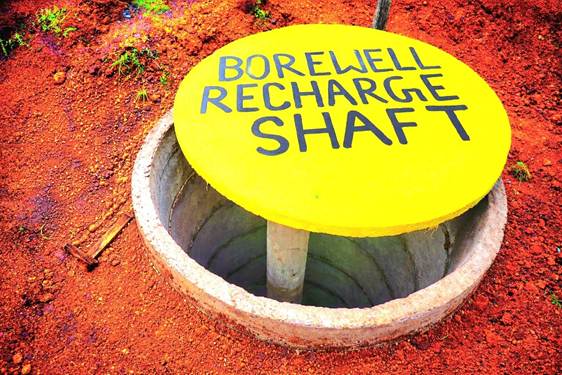
- Install recharge pits and shafts at suitable locations.
- Repair unused borewells to facilitate groundwater recharge.
- Restore baolis, wells and traditional water bodies.
- Desilt ponds and reservoirs to enhance water retention.
- Promote tree plantation in water retention and recharge areas.
Jal Sanchay Jan Bhagidari 1.0 (2024)
In 2024, Jal Sanchay Jan Bhagidari 1.0 (JSJB) was implemented from 1 April 2024 to 31 May 2025, strengthening community participation in water conservation.
The initiative followed the principles of Community, CSR, and Cost – the 3Cs. It also mobilised convergence with ongoing government schemes to accelerate water conservation efforts.
The initiative promoted low-cost groundwater recharge and water storage structures. It also supported the revival of defunct borewells and locally appropriate solutions.
During this campaign, more than 10 lakh (1 million) groundwater recharge structures were constructed, with more than 27 lakh (2.7 million) artificial recharge structures reported.

Jal Sanchay Jan Bhagidari 2.0 (2025)
On 1 June 2025, Jal Sanchay Jan Bhagidari 2.0 was launched, built upon the earlier initiative.
It focused particularly on groundwater recharge in over-exploited and critical districts.
The approach emphasised low-cost and hyper-local interventions.
In November 2025, the 6th National Water Awards recognised exemplary contributions under JSJB 1.0.
Jal Sanchay Jan Bhagidari: Catch the Rain (2026)
The 2026 initiative, launched on June 1, 2026, expanded the JSJB approach by integrating it with the Jal Shakti Abhiyan: Catch the Rain campaign.
The campaign focused on rainwater harvesting, groundwater recharge, water conservation, creation of water assets, and community participation.
It promoted locally appropriate, low-cost interventions and strengthened climate resilience through sustainable water management.
The campaign leveraged convergence across several government schemes, including VB-G RAM G, Per Drop More Crop under PM Krishi Sinchayee Yojana (PMKSY), Repair, Renovation and Restoration of Water Bodies under PMKSY, CAMPA, Finance Commission Grants, and other state government schemes.
The initiative brought together Panchayati Raj Institutions, urban local bodies, women’s groups, youth, educational institutions, civil society organisations and local communities.
These stakeholders support planning, implementation and community-led water conservation.
Technology-led systems, a web portal, and a mobile application have strengthened transparency, monitoring, and public feedback.
Jal Shakti Abhiyan: Catch the Rain Focus Areas
Ever since the Catch the Rain campaign was implemented, it has been coming up with annual themes and focus areas:
| Year |
Theme / Focus |
Key Areas of Activity |
| 2021 |
Catch the Rain, Where It Falls, When It Falls |
Rainwater harvesting & water Conservation; Geo-tagging of water bodies; Scientific water conservation planning; Jal Shakti Kendras and awareness activities |
| 2022 | Expanding Water Conservation Activities |
Restoration of traditional water bodies; Groundwater recharge and watershed development; Wetland and river rejuvenation; Spring-shed development and catchment protection |
| 2023 | Source Sustainability for Drinking Water |
Focus on 150 water-stressed districts; Strengthening drinking water sources; Groundwater recharge and source sustainability; Field monitoring and community participation |
| 2024 | Nari Shakti se Jal Shakti |
Women-led water conservation initiatives; Desilting and cleaning of water bodies; Revival of abandoned borewells for recharge; Afforestation and rejuvenation of local water resources |
The 2024 campaign highlighted women-led water conservation initiatives.
Their contributions continue to be recognised through the Swachh Sujal Shakti Samman, celebrating exemplary efforts in water conservation, sanitation, and hygiene.
Jal Shakti Kendras
Jal Shakti Kendras (JSKs) serve as district-level knowledge and facilitation hubs. They support communities and local administrations through:
- Providing information on water harvesting techniques
- Providing technical guidance
- Supporting water conservation planning and implementation
From Rainwater Harvesting to Rural Resilience
Water conservation has evolved into a community-driven movement focused on sustainable water management.
Initiatives such as Catch the Rain and Jal Sanchay Jan Bhagidari promote rainwater harvesting, groundwater recharge, and restoration of water bodies.
Scientific planning, local ownership, and resource convergence are strengthening water security, rural livelihoods, and climate resilience.
By linking community ownership with convergence, digital oversight, and asset creation, the Jal Shakti Abhiyan: Catch the Rain campaign is laying the foundation for a water-secure India.





Add comment