

 changeadmin
India’s energy transition is increasingly anchored in renewable energy to strengthen energy security and sustainability. The country is rapidly expanding solar and wind capacity to meet rising electricity demand with cleaner sources.
As of July 2026, India has crossed 300 GW of installed non-fossil fuel-based electricity generation capacity. During FY 2025–26, India added around 55.29 GW of non-fossil fuel capacity.
India has also set a target of 500 GW of non-fossil fuel capacity by 2030, with solar and wind energy contributing significantly to achieving it.
However, renewable energy generation varies with sunlight, weather and daily demand patterns. This variability creates a growing need to store electricity when renewable generation exceeds demand.
Energy storage offers a solution by supplying electricity during periods of low renewable generation or peak demand. As renewable capacity expands, the need for energy storage will increase rapidly.
Alongside Battery Energy Storage Systems, Pumped Storage Projects (PSPs) are emerging as a complementary energy storage solution for integrating renewable energy into the grid.
India’s Central Electricity Authority (CEA) projects 73.93 GW of storage capacity by 2031–32. This includes 26.69 GW from Pumped Storage Projects (PSPs) and 47.24 GW from Battery Energy Storage Systems (BESS).
India is Scaling Up Pumped Energy Storage
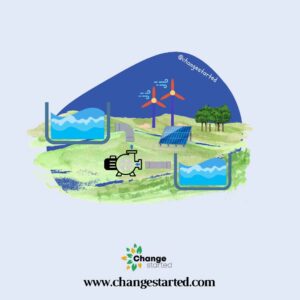
Pumped storage systems store electricity by pumping water to an upper reservoir during periods of surplus generation, then release it through turbines when electricity demand rises.
Pumped storage requires suitable geographical conditions but can provide large-scale storage over extended periods. Their long operating life also supports sustained grid infrastructure needs.
India has a diverse array of mountain systems and hilly terrain, from the towering Himalaya of the north to ancient, eroded plateau ranges in central, western and southern India.
With this geographical advantage, India is rapidly expanding its pumped storage capacity to support its growing renewable energy base.
Many projects are progressing across operational, construction, and pre-construction stages. This expanding pipeline is strengthening India’s long-duration energy storage infrastructure.
Operational Capacity: As of August 2026, India has 7.43 GW of operational PSP capacity across 10 projects. The projects have installed capacity above 25 MW.
Under Construction/Implementation Stage: A further 15.87 GW across 11 PSPs is under construction and/or implementation nationwide.
Next Stage of Pipeline: The Central Electricity Authority has concurred with or appraised 10.40 GW across 8 projects.
India’s Regionally Diverse Pumped Storage Potential
India has identified 320 pumped storage projects with a combined potential of 345.38 GW. This includes 62 on-stream projects (56.67 GW) and 258 off-stream projects (288.71 GW).
These projects span all five regions and include different stages of development, including projects already in operation.
PSP development and site suitability require assessment of several technical and environmental aspects. These include topography, geology, hydrology, reservoir characteristics, foundation conditions, seismicity and environmental considerations.
Project appraisal also examines construction materials, power potential, and transmission connectivity. The Western Region has the highest identified potential at 129.72 GW.
CEA attributes this mainly to topography and steep river gradients originating in the Western Ghats. Maharashtra accounts for 67.36 GW, followed by Gujarat with 33.36 GW.
The Southern Region has 97.76 GW, led by Andhra Pradesh, Telangana and Tamil Nadu.
The Eastern Region has 53.41 GW, including 41.53 GW in Odisha.
The Northern Region has 50.32 GW, led by Uttar Pradesh and Himachal Pradesh.
The North Eastern Region contributes 14.18 GW to the identified national potential.
Collectively, these regional resources underline the scale and spread of India’s pumped storage opportunity.
Projected Capacity Addition of Pumped Storage Projects
This extensive resource base provides a strong foundation for scaling long-duration energy storage.
The Central Electricity Authority has therefore mapped a substantial capacity addition pathway through 2035–36.
Projects totalling 100.81 GW are envisaged for commissioning by 2035–36. This includes projects already under construction and would take cumulative PSP capacity to 105.56 GW.
The planned expansion can significantly strengthen grid flexibility and enable greater integration of renewable energy. It also positions pumped storage as an important pillar of India’s future electricity system.
| Year | Addition (GW) | Cumulative (GW) |
| Up to 2024-25 | – | 4.745 |
| 2025-26 | 2.68 | 7.425 |
| 2026-27 | 2.92 | 10.345 |
| 2027-28 | 1.6 | 11.945 |
| 2028-29 | 6.35 | 18.295 |
| 2029-30 | 13.5 | 31.795 |
| 2030-31 | 21.19 | 52.985 |
| 2031-32 | 8.8 | 61.785 |
| 2032-33 | 14.59 | 76.375 |
| 2033-34 | 11.88 | 88.255 |
| 2034-35 | 5.7 | 93.955 |
| 2035-36 | 11.6 | 105.555 |
| Total | 100.81 |
Global Installed Capacity PSPs
Pumped Storage Hydropower is the world’s most widely deployed form of large-scale energy storage, reflecting its established scale and maturity relative to other storage technologies.
Global installed pumped hydro capacity stood at 159.8 Gigawatts at the end of 2025, according to the International Renewable Energy Agency (IRENA).
| Countries | Installed Pumped Storage Capacity (2025) |
|---|---|
| China | 65.94 GW |
| Japan | 21.85 GW |
| United States | 18.93 GW |
| India | 7.18 GW |
| Germany | 5.34 GW |
China accounted for nearly 66 Gigawatts of this capacity, followed by Japan and the United States with around 22 Gigawatts and 19 Gigawatts, respectively.
India ranks fourth globally in installed pumped storage capacity, with 7.18 Gigawatts at the end of 2025.
The country’s capacity has since increased to 7.43 Gigawatts as of July 2026, reinforcing its growing role in the global pumped storage landscape.
Government Initiatives and Measures
The Government of India has taken a series of coordinated policy, regulatory, demand-side and supply-side measures to promote the development and deployment of PSPs.
Dedicated PSP Development Guidelines: The Ministry of Power notified the Guidelines to Promote Development of Pumped Storage Projects in India in April 2023.
The guidelines provide a policy framework for facilitating faster PSP development.
Support for Enabling Infrastructure: Budgetary support covers essential infrastructure required for PSP development.
This includes roads, bridges, railway sidings, ropeways, communication facilities and transmission lines. These measures improve project connectivity and strengthen project viability.
Competitive Procurement Framework: Tariff-Based Competitive Bidding (TBCB) Guidelines were notified in February 2025.
They provide a transparent and standardised framework for procuring storage capacity and stored energy from PSPs.
Inter-State Transmission System Charge Waiver: PSPs awarded for construction by 30 June 2028 are eligible for a 100% ISTS charge waiver.
The waiver applies for 25 years from commercial operation. This measure strengthens PSPs’ financial viability.
Faster Project Approvals: Revised CEA guidelines have reduced Detailed Project Report concurrence timelines. The timeline has been reduced from 90 days to 50 days for all PSPs.
The requirement to clear inter-state aspects has also been removed. These measures support faster project development.
Streamlined Environmental Appraisal: The Ministry of Environment, Forest and Climate Change has introduced differentiated appraisal provisions for PSPs.
Eligible projects can benefit from B2 categorisation under the applicable provisions. Off-stream projects also benefit from reduced baseline data requirements.
These measures can accelerate environmental appraisal while maintaining regulatory safeguards.
Facilitating Survey and Investigation: MoEF&CC extended forest land survey provisions and enhanced borehole exploration limits for PSPs, facilitating timely preparation of technically robust Detailed Project Reports.
Integrated Grid and Transmission Planning: National electricity planning integrates energy storage and transmission development.
This approach addresses renewable energy variability, reduces congestion and strengthens grid reliability. A roadmap envisages integrating 100 GW of PSP capacity between 2025–26 and 2035–36.
Digital Project Monitoring: The Central Electricity Authority’s Jal Vidyut DPR portal enables real-time monitoring of survey and investigation activities.
It also facilitates coordination among stakeholders during project preparation. This digital approach helps streamline approvals and accelerate PSP development.
Review of the limit of capital expenditure requiring the concurrence of the CEA: In August 2025, the Indian Government has revised the capital expenditure limit for schemes related to setting up hydro generating stations to ₹3,000 crore, requiring CEA concurrence.
Further, off-stream closed-loop pumped storage schemes, irrespective of the quantum of capital expenditure, have been exempted from the requirement of concurrence by the CEA
These measures spanning policy clarity, fiscal support, streamlined clearances, competitive procurement and integrated grid planning have created an enabling environment for the accelerated development of PSPs.
Energy Transition’s Next Imperative
India’s target of achieving 500 Gigawatts of non-fossil fuel capacity by 2030 represents a fundamental shift in the country’s electricity landscape.
As renewable energy plays a larger role, the ability to store energy and deploy it in line with demand will become increasingly important to maintaining a reliable, balanced power system.
Pumped Storage Hydropower is well positioned to meet this need by providing large-scale, long-duration energy storage while supporting a range of broader power system requirements.
Its role extends from managing peak demand and integrating variable renewable energy to strengthening grid flexibility and resilience.
As the clean energy ecosystem continues to evolve, deploying energy storage effectively alongside generation and transmission infrastructure will be central to building a cleaner, more flexible power system prepared for the future.





Add comment