


 changeadmin
Researchers have identified a new mechanism for generating and controlling spin currents using sound waves, which could reduce energy consumption, have potential applications in quantum computing, and contribute to next-generation communication technologies.
In modern technology, there is a growing demand for faster, smaller, and more energy-efficient devices. Traditional electronics rely on the movement of electric charge, which leads to heat generation and energy loss.
To overcome these limitations, researchers are exploring alternative ways of transmitting information. One promising direction is spintronics, where information is carried by spin rather than electric charge.
In this context, magnons, which are the waves of magnetic disturbances inside materials, are emerging as potential carriers of information. They are particularly attractive because they can operate with much lower energy loss compared to electrons.
Researchers from the Institute of Nano Science and Technology (INST), Mohali, an autonomous institute of the Department of Science and Technology (DST), have introduced a new mechanism to generate and control magnon-based spin currents (spin wave excitations) using surface acoustic waves (SAWs).
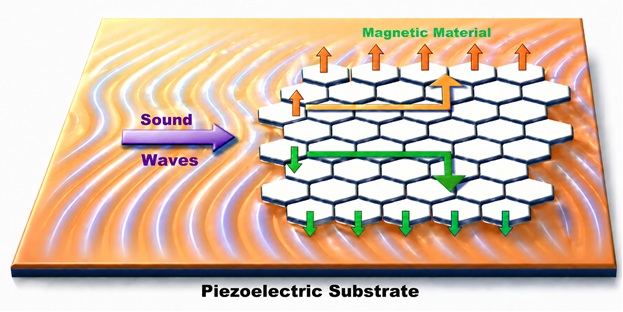
Fig: Schematic diagram of the Sound Waves induced magnon spin current in a graphene-like magnetic material (technically speaking, antiferromagnet material) placed over a piezoelectric substrate. Piezoelectric materials are materials which generate electricity in response to the applied external pressure
Mr Shivam Sharma, a PhD scholar, and his supervisor, Prof. Abir De Sarkar, identified a gap in earlier studies showing that surface sound waves can influence electron dynamics and that magnon dynamics can be governed by quantum geometric quantities, and developed a new theoretical approach to address this gap.
They developed an analytical model from scratch that considers a two-dimensional, ultrathin, graphene-like material with a magnetic structure. The material is deposited over the piezoelectric substrate. Using the model, they studied the effect of surface sound waves on magnon transport.
They found that when surface acoustic waves travel through a material, they create tiny distortions that act as effective forces (called pseudogauge fields) influencing the motion of magnons, thereby providing a new way to generate spin currents in two-dimensional magnets using surface acoustic waves.
This approach, published in the journal Physical Review B, opens new possibilities for low-power, highly efficient technologies.
With applications in low-power information processing and strain-engineered devices (where mechanical deformation controls electronic or magnetic behaviour), the work is especially relevant to next-generation computing, where reducing energy consumption is a critical goal.







Add comment