

 changeadmin
As the world’s electricity generation increasingly shifts from thermal to renewables (solar and wind), energy storage systems are needed because electricity must be available when people need it.
Solar power is unavailable at night, while wind generation changes with weather conditions. Renewable projects can also sometimes produce more electricity than the grid can immediately absorb.
Energy storage saves surplus renewable electricity and supplies it when the sun is not shining, or the wind is weak.
Energy storage technologies can respond within seconds to fluctuations in frequency and voltage, helping maintain a stable electricity supply.
To enable energy storage, solutions such as pumped storage and battery energy storage systems are increasingly favoured.
Battery energy storage is an integrated technology that captures electrical energy in rechargeable batteries and releases it when needed, while pumped storage uses water and gravity to store electricity.
Understanding Pumped Storage Projects (PSPs)
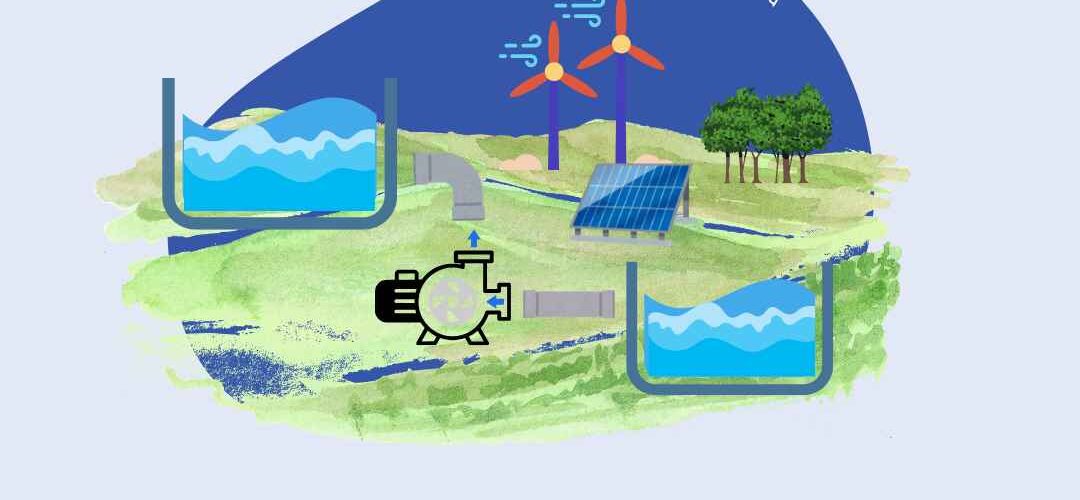
Often described as a water battery, a Pumped Storage Project typically consists of two reservoirs located at different elevations that use gravitational potential energy to balance electricity supply and demand.
During periods of surplus electricity, operators pump water from the lower to the upper reservoir, often using renewable power like solar or wind.
When electricity is needed, operators release water from the upper reservoir through turbines to generate electricity.
Once demand subsides, operators pump water back to the upper reservoir during periods of surplus electricity, completing the storage cycle.
Pumped storage systems therefore function as large-scale energy storage systems and contribute to grid stability and renewable energy integration.
This simple but powerful mechanism provides rapid, flexible grid balancing at multihour durations, making PSPs a cornerstone of modern decarbonised power systems.
Benefits of Pumped Storage Systems
A major benefit of pumped storage systems is their ability to integrate renewable energy, reduce energy wastage and support a cleaner electricity system.
Solar and wind power are variable, but pumped storage can absorb surplus electricity when sunshine or wind generation is high and release it when renewable output declines.
Pumped storage also improves grid stability it responding quickly to changes in electricity demand, regulating frequency and voltage, and providing reserve power during unexpected outages. Its black-start capability can help restore electricity networks after a major blackout.
Unlike many batteries, pumped storage can provide electricity for several hours and suits daily or extended periods of high demand.
It also has a long operating life, low operating costs, and can reduce dependence on fossil-fuel-based peaking power plants.
Categorising Pumped Storage
Pumped storage systems are classified by how their reservoirs connect to, or relate to, natural watercourses.
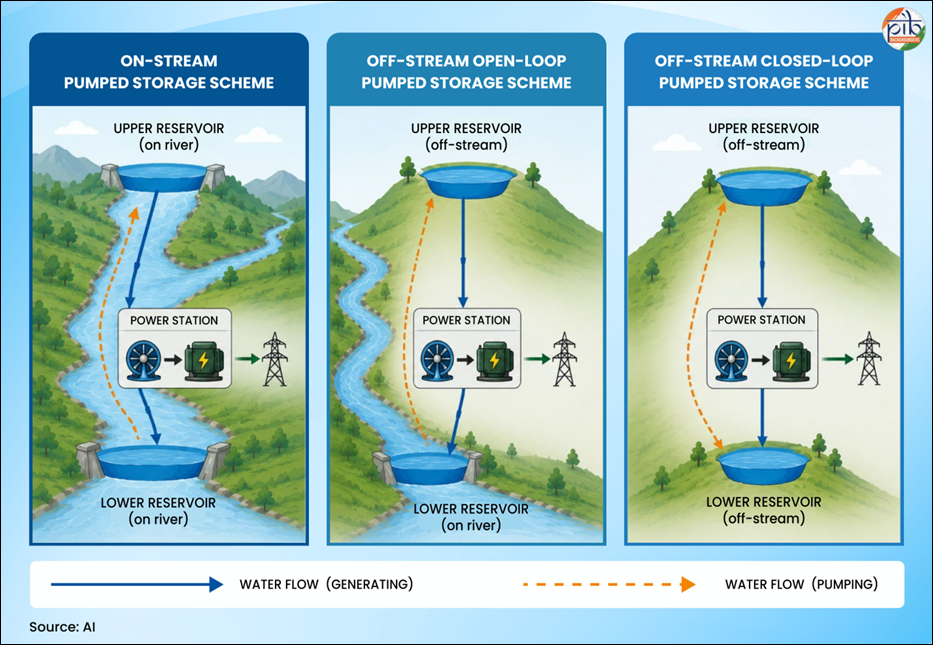
They fall into three types: on-stream, off-stream open-loop, and off-stream closed-loop schemes.
These configurations reflect the varying association between a project’s reservoirs and natural watercourses.
On-stream Pumped Storage
On-stream pumped storage schemes have both reservoirs located on a river, stream or nallah.
To meet the electricity demands, water stored in the upper reservoir flows through turbines to generate electricity.
During periods of low electricity demand or surplus power, water is pumped back to the upper reservoir for reuse.
Off-stream Open-loop Pumped Storage
Off-stream open-loop pumped storage schemes have one reservoir located on a river, stream or nallah.
In contrast, the other reservoir is not located on a river, a perennial stream, or a perennial nallah.
When electricity is required, water flows from the upper reservoir through turbines to produce electricity.
Surplus electricity is subsequently used to pump the water back, restoring the system for another cycle.
Off-stream Closed-loop Pumped Storage
Neither reservoir in an off-stream closed-loop pumped storage scheme is located on a river, perennial stream or perennial nallah.
Both reservoirs are situated away from perennial natural watercourses.
When electricity is required, water flows from the upper reservoir through turbines to generate power, then is pumped back to the upper reservoir during periods of low electricity demand or surplus power.
All three types of pumped storage projects play a role based on site-specific geographical and technical conditions.
However, efforts are underway to identify more off-stream projects away from rivers, supporting faster execution and minimising impacts on aquatic ecology and the surrounding environment.
Wrapping Up
Pumped storage systems offer a scalable, durable, and economically attractive tool to integrate renewables, stabilise the grid, and ensure reliable power as countries transition to net zero.
With strategic siting, stakeholder engagement, and supportive policy, pumped energy storage can become a backbone of a resilient, low-carbon energy infrastructure.






Add comment