

 changeadmin
What flows away from homes, businesses, and neighbourhoods doesn’t have to become waste. With the right systems, communities can collect, treat, recycle, and return used water for productive use.
Many Indian cities are turning used water into a resource, and this shift is shaping a new approach to urban sanitation under the Swachh Bharat Mission-Urban (SBM-U).
At its heart is Used Water Management (UWM), which focuses on treating used water, preventing untreated sewage from reaching water bodies, and enabling safe reuse.
Sewage Treatment Plants (STPs) are central to this process, turning wastewater management into an opportunity to protect natural resources and recover water for further use.
This approach is reinforced through the Water Plus certification, which provides cities with guidelines for managing wastewater generated by households and commercial establishments.
It requires wastewater to meet treatment standards before discharge into the environment. The focus extends beyond treatment infrastructure to how cities plan and manage their water resources.
Urban Local Bodies are being empowered to formulate long-term, city-level plans for wastewater treatment and reuse. Clearly defined responsibilities and technological advancements are helping cities improve the efficiency and effectiveness of treatment systems.
The Open Defecation Free (ODF) ++ protocols further strengthen this approach by assessing the safe management and treatment of the entire sewage stream, including faecal sludge and septage.
Together, these measures are laying the foundation for sustainable sanitation and a circular economy, where used water can be managed as a resource.
Under SBM 2.0, projects worth ₹11,785 crore have been approved for setting up sewage treatment plants in small cities.
These projects will add 4,900 million litres per day (MLD) of treatment capacity, expanding the infrastructure needed for effective used water management.
Where Used Water Finds a Second Life
Used water management is evolving beyond conventional treatment and disposal. Different Indian cities are developing approaches that match their infrastructure, water needs and local conditions.
In the process, treated water is finding applications in agriculture, horticulture, industry, road cleaning and lake rejuvenation.
Cities like Jaipur, Indore, Surat and Navi Mumbai highlight some of these varied approaches.
Jaipur: Engineering Water Reuse at Scale
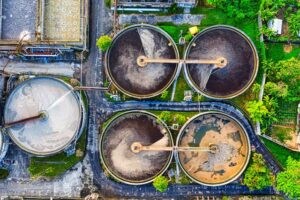
Built over 22.50 hectares during 2020–23, the Dehlawas Sewage Treatment Plant in Jaipur has Rajasthan’s highest sewage treatment capacity, at 215 MLD.
The plant performs wastewater treatment and converts it into a reusable resource, promoting circular economy principles and water conservation.
This high-technology plant is fully automated through a Supervisory Control and Data Acquisition (SCADA) system.
Jaipur STP is currently equipped with a highly efficient Sequencing Batch Reactor (SBR).
In this process, wastewater passes through a Parshall flume, primary clarifier and basin before reaching the chlorine tank. It is then treated to produce clean water.
Primary sludge thickeners and screw press machines separate solid waste. After treatment at the STP, wastewater becomes a valuable resource again.
It is being reused for irrigation and various industrial processes, a practice known as wastewater recycling, which is also an economically viable option.
Currently, a portion of the treated water is supplied to a nearby colony for gardening and other purposes.
The remaining clean water is discharged into the Dravyavati River, and measures ensure untreated wastewater does not enter the river.
A green area has also been developed around the plant, with more than 30,000 plants adding to the site’s greenery.
Indore: Leading the Water Plus Journey
Indore’s transformation in used water management began with a simple goal: keep untreated wastewater out of the environment. This approach helped the city become the first to receive Water+ Certification.
Its practices demonstrated how sustainable sanitation and used water management could work at the city level. The model has also encouraged several smaller cities to pursue similar approaches.
Today, no untreated wastewater flows through Indore’s rivers or its natural and man-made stormwater drains. By 2020, the city had 7 decentralised STPs alongside 3 existing centralised STPs.
It also laid more than 200 kilometres of piped network to carry treated wastewater.
Indore also strengthened measures to conserve both groundwater and surface water. In 2022, more than 1.25 lakh rainwater harvesting units were installed across residential and non-residential areas.
The installations were completed in just four months. Treated wastewater is now used for water gardens, roadside plantations and horticulture. It is also used to wash roads and clean sewer machines.
Surat: Making Wastewater Treatment an Economic Resource
Surat has taken wastewater treatment further by treating it as an economically valuable resource.
The Surat Municipal Corporation has established four tertiary treatment plants with a combined installed capacity of 116 MLD. These plants have helped reduce dependence on freshwater resources.
The city reuses treated wastewater across several non-potable applications. These include industrial use, lake rejuvenation, agriculture, mass plantation, sewer cleaning, etc., through direct service lines and tanker filling stations.
The city has 170 sewer-cleaning machines, including equipment based on the latest advanced robotic technology. These machines clean and maintain the sewerage system.
Navi Mumbai: Reuse Built into City Services
Navi Mumbai’s Water+ journey has combined treatment infrastructure with extensive reuse of treated water. It is the only city in Maharashtra to achieve a five-star rating and Water+ Certification.
The city upgraded its sewage treatment technology and designed its STPs for a population of 30 lakh. It also upgraded its pumping stations to reduce energy costs.
These stations transfer sewage generated to the STPs. The corporation undertook preventive maintenance of the sewer network to avoid hotspots.
Navi Mumbai Municipal Corporation has achieved 100% mechanised cleaning of sewer lines and septic tanks and centrally monitors all septic tanks through Level Transmitters installed across the city.
More than 30% of treated water is reused in over 30 city gardens. It is also used to wash solid-waste vehicles, compactors and city transport buses.
Sprinklers and road dividers also use treated water, reducing dependence on freshwater.
Tirupati: A Revenue Model for Treated Water
Tirupati has developed a self-sustaining model for operating a sewage treatment plant at Thukivakam. The city has also been declared Water Plus.
Built at a cost of ₹19 crore, the STP has an installed capacity of 50 MLD and serves 1,04,057 households across the city.
Of the treated water, 24 MLD is reused for various purposes. The plant sells 5 MLD of treated used water to Srikalahasthi Pipes Ltd. As a result, the plant generates net revenue of Rs. 6 Lakhs per month.
The plant supplies another 18 MLD of treated used water free of cost to farmers for agriculture. The ULB also reuses a portion for road and street cleaning.
The ULB also uses treated water to water road medians, parks, and gardens across the city. These measures help maximise treated-water reuse.
Tirupati’s wastewater treatment approach combines water reuse with a revenue-generating model to support sustainable STP operations.
A Shift in the Urban Water Story
The growing focus on used water management and wastewater treatment is changing how cities approach their water needs.
Treatment is no longer only about preventing pollution. It is also about recovering water for productive use.
Treated water is finding new uses in irrigation, industry, horticulture and everyday urban services.
As more cities strengthen treatment capacity and develop reuse systems, urban water management is becoming more circular and resource-efficient.
This shift helps build cleaner sanitation systems while making better use of every available water resource.




Add comment