

 changeadmin
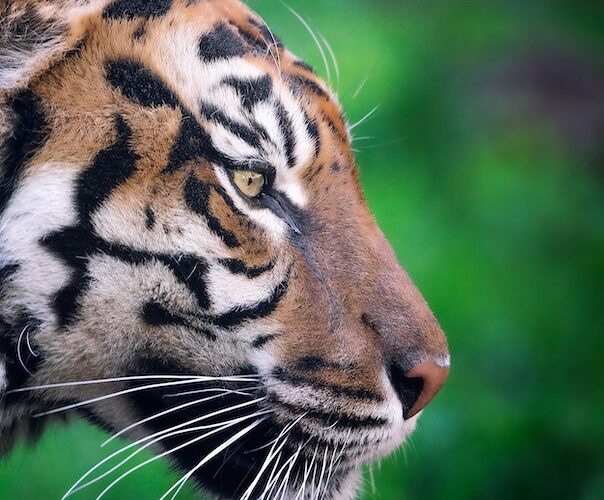
International Tiger Day, or Global Tiger Day, is celebrated annually on July 29.
Since the beginning of the twentieth century, there’s been a significant decline in the tiger population worldwide. But fortunately, considerable efforts are being made to increase the tiger population globally.
Celebrating Global Tiger Day is also part of raising awareness about tiger conservation.
History of International Tiger Day
The decision to celebrate July 29 as International Tiger Day annually was taken in the year 2010 at Saint Petersburg Tiger Summit held in Russia. At the summit, the governments of 13 tiger-populated nations signed a declaration and pledged to double the wild tiger numbers by 2022.
Reasons behind the decreasing tiger population:
Let us first understand the reasons behind the declining tiger population.
-
Habitat loss:
Due to the increasing human population, deforestation is on the rise. Clearing the forests for many reasons, such as industries, agriculture, etc., has resulted in losing about 93 percent of the wild cat habitats.
-
Poaching and illegal trade:
The wild tigers are prone to inhumane poaching to produce traditional medicines. There is an increasing demand for tiger body parts such as skin and bone, which has increased the poaching and illegal trade of tigers.
-
Diseases:
Diseases are also one of the major reasons for the decline of the tiger population. Many animals, including tigers, die due to the spread of epidemics such as tuberculosis, Feline Panleukopenia, etc.
-
Climate change:
The rising sea level of climate change has inundated many tiger belts close to water bodies. India’s mangrove belt, Sundarbans, is one of the Royal Bengal Tiger’s major habitats, and the region is getting depleted due to rising water levels.
Importance of Global Tiger Day:
Observing Global Tiger Day is important because, according to WWF (World Wildlife Fund), the world has lost about 95 percent of the tiger population in the past 100 years.
Only about 3,900 wild tigers are left compared to about 100,000 tigers a century ago. Animal organizations, including WWF, SCBI (Smithsonian Conservation Biology Institute), and the IFAW (International Fund for Animal Welfare), organize several events yearly to raise awareness about conserving tigers.
The Success Story of Tiger Conservation in India:
India has 53 tiger reserves covering over 75,000 sq. km, and there are more than 3500 tigers in India presently, which is almost 70 percent of the worldwide wild tiger population. Until 2006, the tiger population in the country was about 1,400.
The rise in India’s tiger population can be accredited to the introduction of the tiger protection initiative Project Tiger in 1973. It is due to this conservation program that India now has the highest tiger population across the globe.
A detailed report of the Tiger Census-2018 showed that the tiger population in the country has risen by more than 700 tigers in 4 years, i.e., from 2014-2018. As per the report, Uttrakhand’s Corbett Tiger Reserve has 231 big cats- the highest tiger population in the country.
Story of Jim Corbett – The hunter and a protector
India is home to 51 tiger reserves and home to 70% of the global tiger population. One of the most visited & famous tiger reserves in India is Jim Corbett Tiger Reserve. The park is named in honor of Edward James Jim Corbett, who contributed extensively to tiger conservation & wildlife.
This park is located in the foothills of the Himalayas, in Nainital in the Indian state of Uttarakhand, and is the country’s first Tiger reserve.
Jim Corbett, born in 1875 in Nanital, spent most of his childhood exploring the jungles of Uttarakhand. In the first 20-30 years of the early 1900s, Mr. Corbett was frequently called to hunt many man-eating tigers in the region. Many of these man-eating tigers have killed more than 200-300 humans.
Later, Jim Corbett discovered that man-eating tigers became human killers because they either carried wounds and diseases or were injured due to human negligence, like wild gunshots. This led him to focus on protecting the striped cats and wildlife.
He authored many books related to his expeditions, Man-Eaters of Kumaon is one of the most successful books, later made as a Hollywood film. His other famous books were My India, Jungle Lore, and The Man-eating Leopard of Rudraprayag. This book is also notable because it was Jim Corbett’s recount of a man-eating leopard, which was extremely rare.
He was instrumental in establishing the park in the 1930s, initially named Hailey National Park. Later on, around 1955, the park was renamed ‘Jim Corbett National Park’ to give tribute to the man who started as a hunter and became a major proponent of wildlife conservation in India.
Tiger is the National Animal of 4 Countries
The government of India launched an initiative, Project Tiger, in 1973 to protect the dwindling population of tigers in their natural habitat. The same year, India declared Royal Bengal Tiger as the national animal of India, replacing Lion.
The royal Bengal tiger (Panthera tigris Tigris) is also the national animal of Bangladesh. South Korea has the Siberian tiger (Panthera tigris altaica) as its national animal. Malaysia has the Malayan tiger (Panthera tigris jacksoni) as its national animal.
Interesting Facts about Tigers
Here is a small video showcasing other interesting facts about the majestic creatures on the planet.
Wrapping Up

There is a famous quote, “Where tigers thrive, it is a sign that the ecosystem is healthy.” Let’s do our bit in conserving and protecting the iconic ‘umbrella species’ by not promoting – poaching, deforestation, and other factors that lead to the decline of tigers.





Add comment