
 changeadmin
If you walk into a popular market in India, there is a very likely chance that you will witness a mountain of white styrofoam boxes gleaming like discarded clouds.
Plastic wrappers, containers, plates, and cups are found crushed into puddles of brittle flakes.
Though these markets are full of colours, vibrancy and life, stitched through a stench of convenience—a reminder that the bustle of the day carried with it a legacy of waste.
Reason: Companies rely on plastic and styrofoam boxes for packaging. Styrofoam is especially useful for cushioning fragile items (electronics, glass, medical devices, fruits and vegetables, etc.).
Plastic and styrofoam (thermacol) have long defined modern convenience, yet their environmental consequences are increasingly untenable. Overflowing landfills and polluted oceans underscore the urgency for alternatives that do not persist for centuries.
In this context, mycelium—the root-like network of fungi (mushrooms)—has emerged as a promising solution—capable of forming durable, lightweight, and fully biodegradable materials.
Unlike plastics derived from fossil fuels, these mycelium-based packaging materials are cultivated from agricultural waste, requiring minimal energy and leaving no toxic residue.
This shift from extraction to growth raises a critical question: can mycelium or mushrooms replace plastics at scale?
Understanding Mycelium
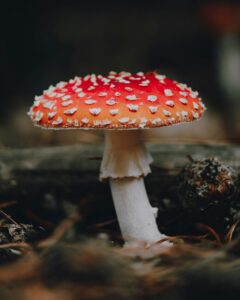
Mycelium is the thread-like, root-like vegetative part of a fungus, consisting of a vast, interconnected network of thin, thread-like strands called hyphae.
It grows underground or within organic matter (such as soil, wood, or compost), secreting enzymes to break down dead material and recycle nutrients back into the ecosystem.
Often called the “wood wide web,” it connects plant roots and helps forests exchange water and nutrients.
Mushrooms have long been known for their food and nutritional value, as well as their cultural value.
Thanks to scientific research and innovation, Mushroom’s root system, mycelium, has emerged as a versatile tool in the fight against climate change.
In addition, mycelium acts as a natural decomposer, carbon sink, and factory for biodegradable materials, such as packaging, leather, and furniture.
Watch this video.
How Does Mycelium Work To Make Packaging
Under controlled conditions (such as a laboratory), mycelium filaments expand rapidly, binding organic substrates such as crop residues, sawdust, or husks into cohesive structures.
These act as a natural bio-binder, transforming low-value agricultural waste into high-performance composites, where manufacturers guide growth within moulds, allowing products to be shaped precisely.
As the mycelium spreads, it secretes natural polymers that fuse the material, achieving strength comparable to synthetic alternatives.
Once the desired structure is formed, heat is applied to stop further growth, stabilising the product.
The result is a versatile material that combines durability, insulation, and biodegradability, making it suitable for packaging, construction, and design applications.
The material made from mycelium is commonly called a mycelium composite (or myco-composite), and when used specifically as a Styrofoam alternative for packaging, it’s often branded as myco-foam.
For ease of understanding, we can also call them mushroom packaging or mycelium packaging.
Comparative Analysis of Packaging Made from Mycelium and Plastic
Here are some broad differences between packaging made from Mycelium and that derived from plastic.
| Comparision | Mycelium Packaging | Styrofoam or Plastic Packaging |
|---|---|---|
| Materials | Made agricultural waste and fungal networks. | Derived from fossil fuels. |
| Resource Efficiency | Requires less energy and utilises natural growth processes. | Energy-intensive and carbon-heavy. |
| Environment Costs | Renewable and eco-friendly. | Contribute significantly to environmental degradation. |
| Biodegradability | Decomposes naturally within weeks, leaving no residues. | Persist for years and degrade into harmful microplastics. |
| End-of-Life Impact | Supports a circular economy. | Waste accumulates in landfills and oceans. |
Performance Characteristics: Mycelium packaging offers comparable strength, cushioning, and shock absorption to plastics like polystyrene, making it suitable for protecting fragile goods.
Insulation Properties: It provides effective thermal and acoustic insulation, sometimes matching or even exceeding synthetic materials in specific use cases.
Scalability Challenges: Plastic benefits from established global manufacturing infrastructure, enabling rapid, large-scale, and consistent production.
Production Constraints: Mycelium requires controlled growing conditions and longer production cycles, which can limit immediate large-scale adoption.
Cost and Adoption: While becoming increasingly competitive, mycelium packaging still faces cost and scalability barriers compared to cheap, mass-produced plastics.
Future Potential: Despite current limitations, mycelium represents a promising, sustainable alternative aligned with global shifts toward eco-conscious materials.
Mycelium Packaging Companies That Are Helping in the Shift
Mushroom Packaging
Mushroom Packaging, a division of Ecovative, is a U.S.-based biotechnology company that has developed sustainable mycelium-based materials to replace styrofoam and plastic.
The company originated from research at Rensselaer Polytechnic Institute, where its founders explored the potential of combining agricultural waste with mycelium to create renewable composites.
Building on this innovation, Mushroom Packaging developed a process that allows mycelium to grow into custom moulds, forming lightweight, fire-resistant, and fully biodegradable materials that reduce reliance on petroleum-based plastic packaging.
GROWN bio
Netherlands-based Grown.bio is advancing sustainable material innovation by harnessing mycelium to create eco-friendly alternatives to conventional packaging.
The company cultivates mycelium on agricultural waste such as hemp fibres, allowing it to naturally bind the substrate as it grows.
Once the desired shape is achieved, the material is dried to halt further growth, resulting in a lightweight, durable, and shock-absorbing product that can replace expanded polystyrene in various applications.
Building on this technology, Grown.bio has developed a diverse product portfolio tailored to multiple industries.
Roha Biotech
Roha Biotech is an India-based startup focused on developing eco-friendly alternatives to conventional plastic and styrofoam packaging using mycelium technology.
Incubated at the IIT Madras Incubation Cell, the company leverages agricultural residue combined with mushroom mycelium to create sustainable packaging solutions.
By utilising organic waste as a raw material, Roha Biotech not only reduces environmental burden but also promotes resource efficiency within the manufacturing process.
These materials are designed to replace traditional petroleum-based packaging while maintaining comparable performance characteristics.
Dharaksha Ecosolution
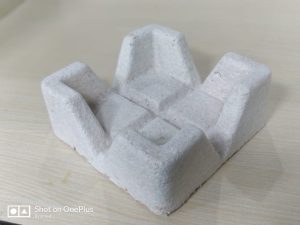
Dharaksha Ecosolution is a biotech company that makes mycelium packaging materials from agricultural waste, which can effectively replace thermocol and styrofoam.
Founded in 2020, the Delhi-based company provide sustainable packaging for food, electronics, and e-commerce products.
Change Started has previously spoken with the co-founder of Dharkasha, Arpit Dhupar, who shared his personal story and journey.
In our interview, Arpit asserts that the packaging made from mycelium and crop stubble is durable, strong, cost-effective, and most importantly, biodegradable.
“Our material is significantly better than thermocol in many aspects – cushioning capabilities, looks, texture, and surface finish, and it is completely biodegradable. There are no raisins, chemicals, binders, or colours involved in the manufacturing of the material.”
Closing the Loop
The transition away from plastic is no longer a question of feasibility but of urgency and execution.
Mycelium-based materials introduce a paradigm shift, redefining production as a biological process rather than an industrial one.
By converting waste into high-performance, biodegradable products, they challenge conventional assumptions about material design and lifecycle.
While limitations in scalability and infrastructure remain, ongoing innovation and industry collaboration are steadily bridging these gaps.
Mycelium may not replace all plastics immediately, but it offers a credible and necessary pathway toward more sustainable systems.
As environmental pressures intensify, materials that integrate seamlessly with natural cycles will become essential.
Mycelium stands at the forefront of this transformation, demonstrating how nature-inspired solutions can drive the transition to a circular economy—one where materials are grown, used, and safely returned to Mother Nature.


Add comment