

 changeadmin
Jute is one of India’s most significant natural fibres, valued for its environmental sustainability. It is a biodegradable, recyclable fibre known for its rapid growth, cost-effectiveness, and wide availability.
The fibre is collected from the jute plant’s inner bark and can be spun into coarse, strong threads. Often called the “golden fibre”, it is the second-most produced plant-based fibre in the world after cotton.
The natural fibre also has a wide range of applications because it is strong, durable, breathable, and highly versatile, making it suitable for sustainable fashion, packaging, construction, agriculture, and industrial textiles.
Additionally, jute possesses favourable functional attributes, including thermal and acoustic insulation, high moisture absorption, and low static generation.
This makes it suitable for blending with both natural and synthetic fibres, enabling a wide range of value-added textile applications, such as Jute Geotextile (JGT).
Jute Geotextile: A Fast-Emerging Sustainable Fabric
Jute Geotextile is a versatile, diversified jute product in the technical textile class, made from jute fibres through special treatment and weaving processes.
This natural fibre is rapidly gaining acceptance because of its functional effectiveness, favourable techno-physical properties, and price competitiveness.
From an ecological standpoint, the fabric is fully biodegradable, thereby improving soil structure and fertility.
It can be applied in many fields, such as civil engineering, soil erosion control, road pavement construction, and riverbank protection, providing a sustainable alternative to synthetic plastic or polymer geotextiles.

Applications of Jute Geotextile
Jute Geotextile has gained recognition as an effective natural material for diverse applications.
Civil Engineering
Denser, heavier jute geotextile fabrics (600–1200 gsm) are widely used for road subgrades, riverbank protection, and soil separation.
This is because of their high initial tensile strength, and their surface roughness enhances soil stabilisation and mitigates erosion.
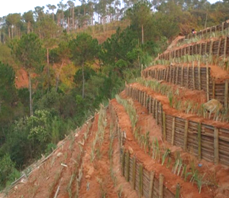
It is utilised for slope protection in earthen embankments, hill cuttings, riverbanks, canals, and rainwater harvesting structures.
Needle-punched fabrics are crafted for specialised drainage and filtration applications, particularly in hilly regions, enabling regulated water flow while preventing soil migration.
JGT is also used to stabilise soft soils through prefabricated vertical drains, accelerating consolidation and enhancing bearing capacity.
Infrastructure Development
In road and haul road construction, as well as in railway track formation, Jute Geotextile improves load distribution and controls settlement.
This reduces maintenance requirements and lifecycle costs.
Soil Protection
Loosely woven meshes control surface soil erosion and stabilise slopes, allowing grass and vegetation to sprout through the openings.
This is because it helps regulate the micro-environment by keeping soil temperatures lower and reducing surface disturbance. As a result, it supports seed germination and early plant establishment.
Wrapping Up
Given the problem of plastic pollution, Jute geotextile provides an eco-friendly alternative to petroleum-based plastics while offering high technical performance in civil and environmental engineering.
Unlike synthetic plastics (polypropylene or polyester), which take hundreds of years to break down and contribute to microplastic pollution and global warming, jute naturally decomposes in soil within 12 to 24 months, leaving no toxic residue.
Abundantly cultivated in regions like India and Bangladesh, jute geotextiles can also provide livelihood opportunities for millions in the region.







Add comment