

 Varun P
If you look at the list of the oldest trees in the world on Wikipedia, you will not find it mentioned.
If you believe in radiocarbon dating, it is just 800 years old.
If you go with the local legends, then this tree is more than 6,600 years old.
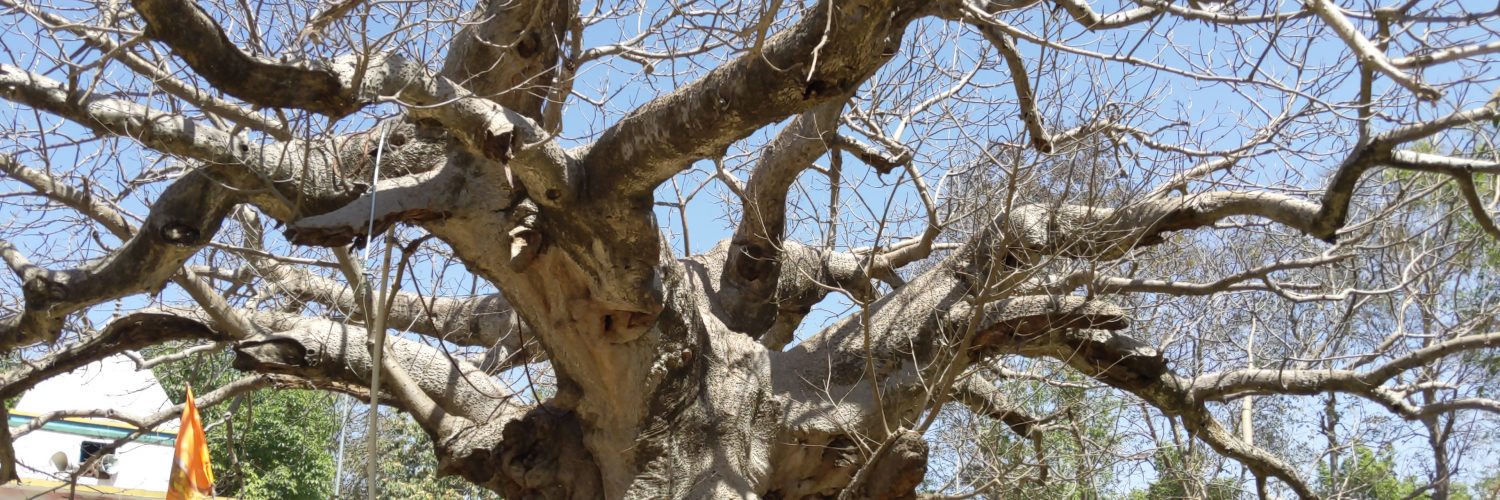
The tree we are referring to here is locally known as Parijat or Parijaat Tree, while its scientific name is Adansonia digitata. It is one of those trees in India considered sacred for its mythological associations.
On one of the Sundays in April, as peak summer was slowly setting in, we got an opportunity to visit the sacred tree, and the majesty of the mighty tree is a sight to behold.
Irrespective of the tree’s actual age, viewing the Parijat tree up close and personal was mesmerising and memorable.
Parijat Tree is located about 70km from Lucknow, in a small Kintur village near Barabanki in the northern Indian state of Uttar Pradesh. It takes a little over an hour from the state capital, Lucknow, to reach the place.
As you make your way to the site of the Parijat tree, passing through other trees and bushes, you will find a small temple near the tree.
The reason for this temple is that Hindus consider the Parijat tree sacred for its historical legends and for its reputation as a wish-fulfilling tree.
Legends behind the Parijat Tree
Let us go through a couple of stories associated with the Parijat Tree.
Arjun brought the Parijat Tree for his mother
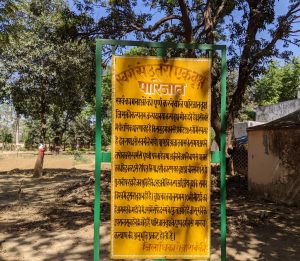
Let me mention the first one, which is mentioned on the noticeboard outside the tree compound.
The headline of the noticeboard written by the local administration is “Swarg se Utra ek Vriksh”, meaning a tree that has come down from Heaven.
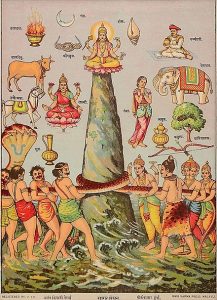
According to Hindu scriptures, ‘Samudra Manthan’, or the churning of the ocean, is one of the most significant moments in history.
Different gifts, treasures, animals, and valuables emerged from that ocean churn, and the Parijat tree is one of them, which is believed to have been taken by Lord Indra to the heavens.
Then, centuries later, during the Mahabharata era, Arjuna, the main hero of the Pandava clan, brought this tree to Earth for his mother, Kunti.
She offered the tree’s flowers to Lord Shiva and prayed for the Pandavas’ victory in the great war (Mahabharata).
The name of the Kintur village and the area name, Barabanki, also seem to be derived from Kunti.
Lord Krishna brought the Parijat Tree for his wife
Another prominent legend in the Hindu text mentions the tree to be brought by Lord Krishna for his wife.
When Lord Narad visited Lord Krishna, he presented flowers from the Parijat tree. Lord Krishna further gave the flowers to his wife Rukmani.
When Lord Krishna’s other wife, Satyabhama, learned of it, she confronted her husband for showing bias and insisted that Krishna bring her the complete tree from the heavens, which was ruled by Lord Indra.
After an altercation with Lord Indra, Lord Krishna brought the tree to the Earth and planted it in Satyabhama’s courtyard. Interestingly, the placement of the trees meant the flowers would also fall in Rukmani’s courtyard.
Facts of the Parijat Tree
The tree is a Baobab (Adansonia digitata), and it comes with peculiar features. The tree sheds its leaves in winter, and in May-June, new leaves sprout, so for six months it is green, and for the rest of the year it remains barren.
The flowering is not always certain, but when it does, it is an incredible sight. The flower is white in colour and appears only in the evening; once it falls, it turns golden after a certain period.
The perimeter of this tree’s trunk is about 50 feet, and its height is about 45 feet.
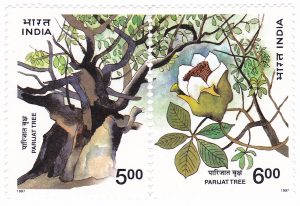
In 1997, India’s 50th year of Independence, the country’s postal department released two commemorative stamps on the Parijat tree.
One stamp shows the tree and is valued at Rs 5, while another, valued at Rs 6, depicts the flower.
Restoration of the Parijat Tree
In 2015, locals complained about the Parijat Tree’s decay due to bacterial and fungal infections.
Scientists from the National Botanical Research Institute (NBRI) treated the tree and applied a chemical treatment. The NBRI team also recommended applying a microbial bio-pesticide to its trunk and leaves to prevent further diseases.
The local administration has now placed a metal fence around the tree and strictly prohibited any damage to it.
Radiocarbon Dating of the Tree
In 2020, scientists conducted radiocarbon dating on the Parijat tree, and their findings indicate that it is around 800 years old and the oldest dated African baobab (Adansonia digitata) outside Africa.
There are no historical records that suggest bringing African baobabs to India; hence, how it came to India and to this village is an unsolved and interesting mystery.
Watch this short video of the Parijaat Tree in Barabanki for a perspective.





Nice article