

 changeadmin
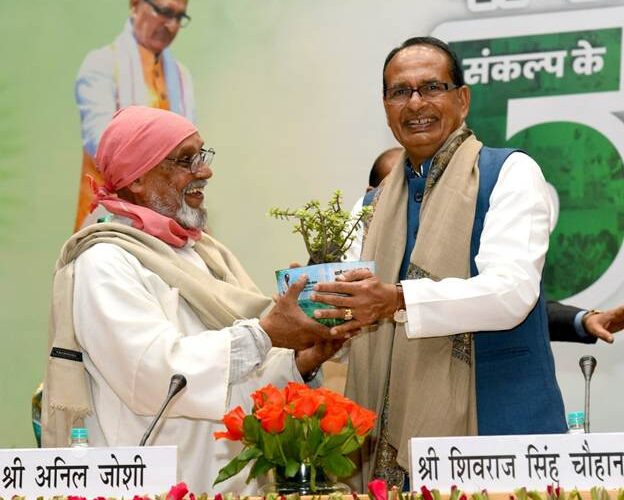
Minister of Agriculture and Farmers’ Welfare, and Rural Development, Shivraj Singh Chouhan took a major resolve to turn environmental protection into a mass movement among nearly 17,000 ‘Vriksh Mitra’ connected from across the country during the ‘Environment Protection Resolve Programme and Vriksh Mitra Samvad’ organised at Pusa Complex in New Delhi.
Padma Bhushan environmentalist Anil Joshi, renowned doctor and social worker Dr Anoop Hazela, Director General of the Indian Council of Agricultural Research Dr M.L. Jat, and hundreds of ‘Vriksh Mitra’ from various states of the country participated in person, while thousands of companions joined through a virtual medium.
Altogether, gave a collective message of saving the earth by connecting trees, water, soil, energy conservation, and plastic-free living with public participation.
Minister Shivraj Singh Chouhan presented a clear and clean roadmap to give environmental protection the form of a concrete mass movement based on suggestions and dialogue received from ‘Vriksh Mitra’.
He decided that every family would plant a tree on occasions like birthdays, wedding anniversaries, the birth of children, and the pious memories of parents, and turn these into ‘Tree Festivals’, so that this tradition slowly becomes a habit in every household.
Every ‘Vriksh Mitra’ will plant at least one tree in a year and resolve to connect at least five new people with this campaign, with the public announcement made through their social media post, so that a strong network can be built by Hariyali Amavasya on 12 August.
Mr Chouhan proposed forming committees of ‘Vriksh Mitra Pariwar’ at national, state, district, block and village levels to run the entire campaign in an organised framework, getting this structure formally registered and identifying fixed sites for plantation in panchayats and urban local bodies, where every auspicious work and government schemes – like Pradhan Mantri Gram Sadak Yojana, Pradhan Mantri Awas Yojana, Lakhpati Didi Yojana, programmes of Agriculture and Rural Development Departments – will start only by planting trees.
Along with this, collective plantation and nature worship on Govardhan Puja, World Environment Day and Hariyali Amavasya, appeal to plant trees in wedding invitation cards and religious-social events, public awareness through saints, social leaders and social media influencers, separate logo and digital portal of ‘Vriksh Mitra’ Family and creating such a social environment in which not planting a tree becomes a matter of shame for people and planting a tree becomes a symbol of progress and prestige, were also resolved.
Resolve to save the Earth with mass movement by ‘Vriksh Mitra’
Minister Shri Shivraj Singh Chouhan began his address by emphasising the seriousness of the environmental crisis.
He clearly said that this is not only a question of the environment but a crisis of human existence – rising sea levels, increasing heat, polluted air, contaminated water, and rapidly disappearing biodiversity pose direct threats to the lives of future generations.
Referring to events happening around the world and scientific facts, he said that if concrete steps are not taken now, the picture for 2050 and beyond could be very worrying.
Shivraj Singh Chouhan said, in an emotional tone, that everyone lives for themselves; true life is the one that gives life to others, and planting a tree is the greatest way to do so.
He said that a tree is not only a green sight but also the oxygen for our breath, a shield that balances the earth’s temperature, a home for birds, insects, and countless other creatures, and a security cover for coming generations.
He also shared that when he plants a tree and sees it growing, it feels as if he is embracing the earth – this feeling is the soul of the ‘Vriksh Mitra Abhiyaan’.
Resolving to plant one tree every year, ‘Vriksh Mitra’, will connect five new companions
Shivraj Singh Chouhan, without limiting the entire programme to just speeches, clearly said that from here today, we have to decide what we will do.
Taking suggestions from many ‘Vriksh Mitra’, he presented a very simple and straightforward resolution – planting at least one tree each year and connecting at least five new people to the tree-planting campaign.
He suggested that everyone must plant a tree on occasions such as their birthday, wedding anniversary, children’s birthday, or a pious memory of their parents; these personal steps will become a collective strength in the coming times.
All ‘Vriksh Mitra’ present in the hall, along with him, took a resolve regarding this. Mr Chouhan said this energy will slowly spread across the country and become a mass movement.
He also motivated the companions who joined virtually to be part of this resolve and gave a clear message that if every citizen plants one tree in a year and inspires five people, then in the coming few years, the picture of Green India can change significantly.
‘Vriksh Mitra Pariwar’ will have a national structure, a national-level campaign
Minister Shri Shivraj Singh announced that tree-planting efforts will not be left scattered or treated as separate initiatives, but rather an organised network will be created under the name ‘Vriksh Mitra Pariwar’.
He said that this will not be an organisation but a family – brothers-sisters, sons-daughters, maternal uncles-nephews-nieces who will be connected with a common feeling to plant and save trees.
He proposed forming a national unit of ‘Vriksh Mitra Pariwar’, then establishing units in every state, district, and block, and ultimately at the village level, to make planning, monitoring, and coordination easier.
He said that when the structure is connected from top to bottom, targets for tree planting can be set in every area, the responsibility for their care can be assigned, and it can be ensured that tree planting is not just a one-time photo event but becomes a continuous campaign.
Massive nationwide plantation on Hariyali Amavasya
Minister Shivraj Singh Chouhan, referring to the importance of trees and water in Indian culture, especially highlighted ‘Hariyali Amavasya’.
He said that our tradition has given trees, ponds and water bodies more importance than sons – statements like “one tree equals ten sons” are proof of our thinking.
On this cultural basis, he proposed that the first major national programme, ‘Vriksh Mitra Pariwar’, will be held on Hariyali Amavasya, which falls on August 12 this year.
Minister Chouhan said that on this day, all ‘Vriksh Mitra’ connected across the country will definitely plant one tree each in their respective areas, and slowly, this day will be known as ‘Tree Festival’ across the country.
He said that if we connect our cultural festivals with the environment – like tree planting on Hariyali Amavasya, distributing saplings on World Environment Day, planting trees on Independence Day and Republic Day – then in the coming few years crores of new trees will stand on the earth and this will strengthen both our culture and environment.
Guarantee of Protection Along with Tree Planting in Panchayats and Urban Local Bodies
Minister Shivraj Singh Chouhan placed greater emphasis on protecting trees than on planting them.
He clearly said that today the biggest crisis is that somewhere trees are planted, photos are clicked, but no one goes back to see whether the tree is alive, whether it is getting water, or whether it has been saved from animals. He said that this tendency has to change – planting a tree is not the goal, making it grow should be the target.
In this context, he suggested that every panchayat should identify two to three acres of land within its area and establish ‘Vriksh Mitra Sites’, where trees are planted regularly, and their care becomes a collective responsibility.
Similarly, every nagar panchayat, municipal corporation, and urban local body should also designate many places in their respective areas for plantation and their monitoring.
He said that when panchayats and urban local bodies provide space and arrangements, and ‘Vriksh Mitra Pariwar’ takes responsibility for trees and their care, then trees will remain safe, and the saplings planted every year will truly become the capital of Green India.
Initiative to secure future agriculture and farmers’ lives
In his address, Shivraj Singh Chouhan connected environmental protection directly with agriculture and the farmers’ future. He said that today, for farmers, the biggest questions are not only about seeds and fertilisers but also about water availability, soil quality, and the long-term health of fields.
He also indicated that, due to unbalanced chemical use and indiscriminate exploitation, soil fertility is decreasing, as a result of which not only production is being affected, but the quality of crops and people’s health are also being adversely affected.
He gave the message of balanced use of water and soil conservation – exploitation only as much as necessary, respect for the soil’s bearing capacity, and expansion of such farming in which the health of the earth is preserved, and farmers’ income is secured.
He said that a scientific approach and social participation are both needed to save the fields, so that in the future, agricultural production and farmers’ lives do not remain insecure in the face of any major environmental crisis.
Making environmental protection a daily habit through mission LiFE, energy conservation and plastic-free living
Minister Chouhan, referring to Prime Minister Narendra Modi’s ‘Mission LiFE (Lifestyle for Environment)’, said that changing lifestyle for the environment is the most effective and permanent solution.
He said that turning off the lights when leaving the room, immediately fixing a leaking tap, not wasting water, separating wet and dry waste, avoiding plastic bags, and including coarse grains and local products in food – these are all small steps, but their effects are very big.
Shivraj Singh Chouhan, agreeing with the energy conservation measures told by Dr Anoop Hazela, said that using LED lights, BLDC fans, energy-efficient ACs and refrigerators is necessary not only to reduce bills but also for the environment.
He said that as the number of electric vehicles increases, both energy production and conservation will become major issues; therefore, from now on, adopting energy-saving devices in every household and institution and removing plastic from daily life are necessary; only then will the real effect of Mission LiFE be visible.
Anil Joshi and Dr Hazela gave a message of behavioural change and ‘adopting one tree’
Padma Bhushan environmentalist Anil Joshi described Minister Shivraj Singh Chouhan’s tree-planting resolve not merely as a tree-planting activity but as a long and inspiring thought.
He said that Shivraj Singh Chouhan’s life and behaviour show that even while in power, a person can work with simplicity, sensitivity and love for nature, and this very thing makes him special.
He said that for years he has been seeing Shivraj Singh’s work and has found no selfish turn in his personality, but rather a constant tendency to work for society and the environment, which is the root of sustainability.
Anil Joshi also said that IIT scientists have started a scientific study of Shivraj Singh Chouhan’s tree planting and environmental works, in which, through remote sensing and other technical means, it will be seen what changes his planted trees and the campaigns he runs have created on the ground.
He said that this study will be a “case study” for policymakers, social organisations and people’s representatives sitting in Parliament in the future, from which they will be able to understand how concrete improvement can be brought in the environment through continuous, simple and people-based efforts.
Renowned doctor and social worker Dr Anoop Hazela, explaining climate change and sustainability in very simple language, said that increasing heat across the world, failing systems, stopping parades and breaking health systems show that this crisis is not limited to any one country or city.
He described energy conservation, the Reduce-Reuse-Recycle model for water, the use of greywater, and the minimal use and recycling of paper and plastic as major verticals for addressing climate change.
Dr Hazela gave the message of “plant one tree, adopt one tree”. He said that those people who live in flats and cannot plant trees on new land can, too, adopt one small plant somewhere while going and coming daily, water it every day, take care of it, and see it grow into a big tree – this is true sustainability.
Giving the example of his hospital, he said that on occasions like World Environment Day, August 15, and January 26, they distribute hundreds of fruit-bearing plants so that every sapling is planted somewhere on the earth and grows into a tree.
He also said that if more and more institutions in the country work toward “Green Certification,” significant improvements in the use of energy, water, waste, and plastic are possible, and, as a result, environmental protection will gain institutional strength.






Add comment