


 changeadmin
In the 139th episode of Mann Ki Baat on this Sunday, India’s Prime Minister Narendra Modi presented environmental sustainability as a lived tradition rather than a distant policy goal.
The address highlighted chemical-free farming, river restoration, eco-friendly packaging, millet revival, and clean festivals, showing how ordinary citizens can make sustainability part of daily life.
The Prime Minister began by recalling India’s long-standing respect for nature, noting that cleanliness and care for water sources were traditionally seen as personal responsibilities.
He used examples from Punjab, Uttarakhand, Karnataka, and the North-East to show that ecological action is emerging from villages, women’s groups, farmers, tribal communities, and young entrepreneurs.
The underlying message was that environmental protection becomes durable when it is rooted in local knowledge, livelihoods, and community pride.
Organic Cotton and Cleaner Textiles
Prime Minister Narendra Modi shared an example from Punjab’s Malwa region, where the Kheti Virasat Mission’s “Nav-Trinjan” initiative is promoting organic cotton cultivation without chemicals.
The project also cultivates naturally coloured cotton, reducing the need for synthetic dyes in yarn and fabric production.
This matters because conventional textile production often relies on pesticides, chemical fertilisers, and dyeing processes that can pollute soil and water.
The initiative also connects ecological farming with women’s livelihoods. Through a weaving school, many women in the region have moved from informal labour into skilled handloom work, producing shawls, towels, and textiles from indigenous organic cotton.
The example demonstrates a useful model for sustainable rural development: protect the environment, preserve traditional skills, and create income at the same time.
Reviving the Heval River
In his Mann Ki Baat speech, Prime Minister Modi shared a water-conservation story that came from Tehri Garhwal in Uttarakhand, where villagers and the local administration joined hands to revive the Heval River.
As the river’s flow declined and nearby natural water sources dried up, the community adopted rainwater capture, groundwater recharge, and large-scale tree plantation.
According to the address, these efforts have helped revitalise the river and restore dozens of natural water sources.
This case is important because it treats a river not as an isolated water body but as part of a wider hydrological system.
Recharge structures and trees help water remain in the landscape, supporting springs, streams, agriculture, and biodiversity.
It also reinforces the idea that communities closest to a resource often understand its restoration needs best.
Sustainable Packaging and Local Products
The Prime Minister linked “Vocal for Local” with environmental responsibility through packaging innovation.
In Maharashtra, tribal communities under “Shabari Naturals” are marketing honey, mahua, chironji, and bamboo-based products in packaging that reflects tribal art; the design received Japan’s Good Design Award.
In Karnataka, a bamboo start-up is developing packaging material from bamboo and agricultural residue, pointing to lower-impact alternatives to conventional packaging.
He also urged citizens to buy local artisan products during the festive season, citing growing demand for Khadi.
Khadi sales through Khadi Gram Udyog exceeded ₹28 crore on Gandhi Jayanti, up ₹1.5 crore from the previous year.
The broader point is that consumer choices can support low-impact materials, rural livelihoods, and traditional crafts while reducing dependence on resource-intensive products.
Success Stories on Millets
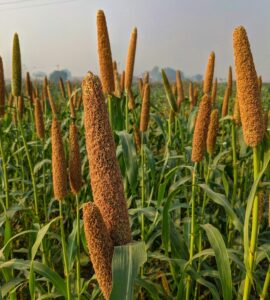
In this month’s Mann Ki Baat address, the Prime Minister once again highlighted success stories on millets, or Shree Anna, as a climate-resilient and culturally rooted food crop.
He recalled how, driven by India’s proposal, the United Nations declared 2023 the International Year of Millets, boosting awareness and demand.
In Meghalaya’s Khanduli village, women created cookies, cakes, muffins, and baby food from millets, increasing demand and encouraging farmers to cultivate them again.
In Nagaland’s Kezoma village, where millet cultivation had stopped for more than a decade, the community revived the crop and held its first millet festival in 2025.
Wrapping Up
Finally, the Prime Minister linked the upcoming Diwali and Chhath celebrations to cleanliness drives, urging citizens to keep their surroundings clean. He argued that small individual actions can create meaningful environmental change.
Taken together, the speech framed sustainability as a combination of clean water, chemical-free farming, responsible consumption, traditional crops, and civic care for public spaces.



Add comment