

 changeadmin
India is facing a growing crisis of marine litter and microplastics, which pose a serious threat to its diverse coastal ecosystems and biodiversity.
With a coastline stretching over 7,500km and home to more than 40 million people, the country generates millions of tonnes of plastic waste annually. Studies indicate that about 60% of this plastic waste ends up in rivers and eventually the sea, making plastics the dominant component of marine debris in India.
Microplastics, tiny plastic particles measuring less than 5mm in size, and marine litter are now widely observed in Indian coastal waters, along the beaches, and even within organisms.
To understand the distribution of microplastics and marine debris levels, India’s Ministry of Earth Sciences (MoES), through the National Centre for Coastal Research (NCCR), has conducted multiple field surveys between 2022 and 2025.
Microplastics
Several scientific studies, including the occurrence, characterisation, spatial and seasonal variability of microplastics and impact on biotic ecosystems, have been conducted along the Indian coast.
As rivers are the principal conduit for litter, data were collected adjacent to the river mouths along the Indian coast. Locations near river mouths had higher concentrations of microplastics, especially during the post-monsoon months.
Assessment of microplastics in both water and sediment has been carried out along the east and west coasts of India. On the west coast, 19 transects were surveyed from Porbandar (Gujarat) to Kanyakumari (Tamil Nadu), while on the east coast, around 25 transects were sampled from Puri (Odisha) to Tuticorin (Tamil Nadu).
The findings indicate that the predominant sources of microplastic pollution are riverine inputs and fishing gear.
Additionally, the National Institute of Oceanography (NIO), Goa, has done a detailed study assessing microplastics in offshore sediments along the eastern Arabian Sea shelf. The findings revealed significant levels of microplastic pollution in marine sediments.
Research was conducted to assess microplastic uptake and influence in the bentho-pelagic region and its associated ecological risks along the coast of Goa. In this study, 9 pelagic and benthic fish and shellfish species were studied, and habitat-wise, higher microplastic contamination was found in the benthic region and sediment compared to the pelagic region and water column.
Microplastics were also found in commercially important finfish, shellfish, and barnacles from Chennai’s highly anthropogenic coastal waters.
Marine Litter
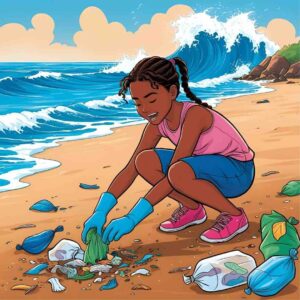
Regarding marine debris, national-level assessment of beach litter is conducted every year during the International Coastal Clean-up Day (on the third Saturday of September) under the programme “Swachh Sagar Surakshit Sagar” covering the coastal States and Union Territories.
The assessments reveal that the major sources of beach litter are tourism-related and recreational activities. However, data indicate a declining trend in beach litter over the years, with plastic litter contributing 67% in 2018 and reducing to 43% in 2024.
Studies have indicated that coastal ecosystems such as mangroves, estuaries and coral reefs are the most sensitive, accumulating marine litter and microplastics.
A plastic litter survey conducted in coastal mangroves along the Goa coast has shown that the average litter was estimated at 5.14 ± 0.55 items/m². Plastic items were ubiquitous, accounting for 66 % of anthropogenic litter. Land-based mismanaged solid waste and public littering were identified as primary sources of litter pollution.
Likewise, a marine litter survey conducted on coastal mangroves along the Maharashtra coast has shown that the average concentration of litter was measured at 8.5±1.9 items/ m2 (ranged 1.4 ̶ 26.9 items/m2). Plastic dominated 83.02 % of all litter deposited on the mangrove forest.
An underwater marine litter survey was conducted along the fringing coral reefs in the Mahatma Gandhi Marine National Park, Andaman and Nicobar Islands. The survey recorded an average litter density of 0.42 ± 0.08 items/m2 (range: 0.23 ± 0.02 to 0.71 ± 0.09) and a mean mass of 138.61 ± 42.15 g/m2 (range: 70.17 ± 7.74 to 303.4 ± 2.55). Plastic was the most dominant litter (60.82 %) recorded in the reef environment.
Marine litter on North Cinque Island, a remote uninhabited island in the Andaman and Nicobar archipelago, Bay of Bengal, has enumerated a total of 6227 litter items with an average concentration of 0.12 items/m2, representing 20 diverse litter types, with plastic dominating the litter composition (86 %).
A marine litter survey was done in the intertidal coral habitats of Mumbai. The average density of marine debris was estimated at 1.60 ± 0.13 items/m2. Plastic materials were the most abundant of all debris registered in the study area, comprising 91.27% of the total marine litter. Single-use plastic bags and wrappers were the dominant plastic debris.
Action to Counter Marine Litter
The roadmap for the National Marine Litter Policy has been formulated by the Ministry of Earth Sciences (MoES) through the National Centre for Coastal Research (NCCR), Chennai. The draft policy document has been circulated to relevant stakeholders, line ministries and agencies for review and consultations.
More than 250 beach cleanup events have been organised by the Ministry of Earth Sciences (MoES) institutes. About 150 tons of beach litter were removed through various programs such as Swachh Sagar Surakshit Sagar, International Coastal Cleanup Day, World Oceans Day, Swachhata Pakhwada, etc.
As part of Community-led measures, NCCR-MoES has conducted several beach clean-up and awareness campaigns since 2018 to raise awareness among students, the public, and the fishermen communities about the ill effects of marine litter and microplastics. These beach cleanup drives involve the public (Citizen Science approach) and spread awareness about marine litter and microplastics.




Add comment