

 changeadmin
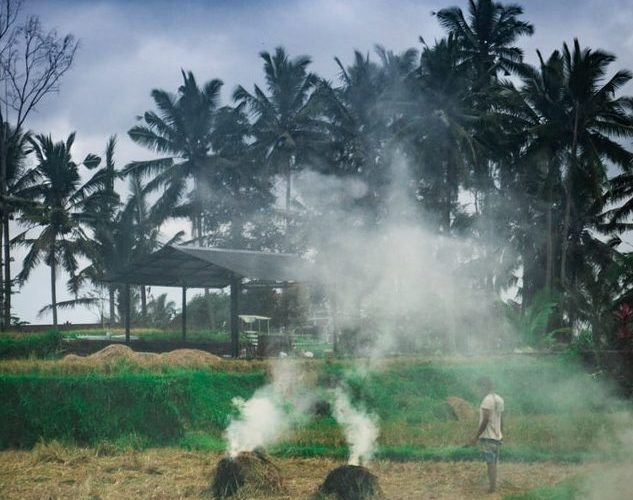
While modern agriculture has given us much in terms of food production and high yields, it has also created its own set of problems, one of which is crop stubble.
With the growing use of machines for paddy harvest and other crops, a heavy trail of crop residue is left behind in the field.
Due to various factors, farmers simply burn their crop residue by setting it on fire, leading to extreme air pollution. This problem is highly prevalent in India, particularly in the Delhi region and many parts of North India.
As one of the world’s leading producers of agricultural products, providing livelihood to millions of people, Indian farmers often resort to crop stubble burning as the easiest option. The common public perception is that these farmers don’t understand the gravity of their actions.
However, in our conversation with Arpit Dhupar, co-founder of Dharaksha Ecosolution, who spent a considerable period in Punjab and Haryana villages to understand the problem, has a different take: “Villagers understand the ill effects of burning much more than people in the city. As they stay much closer to the fields, the smoke hits them first before it reaches the cities.”
Arpit added, “Farmers also know that this is not just the smoke; the chemicals that they have put in the crops make the smoke highly toxic and hazardous. They also understand that it would destroy the organic content and friendly pests in the soil“.
He gave detailed reasoning for the crop stubble burning problem; you can read it here.
While many solutions have been tried to stop the burning, including penalties and financial assistance, farmers continue to burn their agricultural waste, resulting in deaths, health issues, and major economic losses.
India needs solutions that leverage this agricultural waste to build a distinct product that creates new economic opportunities, which further incentivise farmers to stop this stubble-burning practice.
Answering the call, a growing number of Indian startups are providing crop stubble-burning solutions; their innovative products not only help prevent air pollution but also address other environmental issues and, most importantly, boost farmers’ incomes.
GreenJams, started by civil engineer Tarun Jami, creates carbon-negative building materials from crop residues such as paddy straw, cotton stalks, and bagasse. Alongside the problem of crop stubble burning, the Vishakapatnam-based building materials company also supports sustainable construction.
As per the company’s claims, its product Agrocrete helps reduce construction costs by up to 50% and improves building energy efficiency by up to 25%.
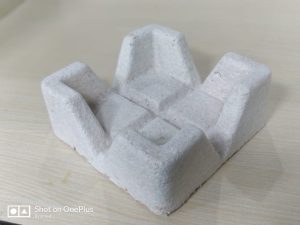
Delhi-based Dharaksha Ecosolution is a sustainable packaging company that makes biodegradable materials from agricultural waste, which can effectively replace Thermocol.
In addition to the crop stubble-burning solution, the Dharaksha solution addresses one of the major culprits of plastic pollution widely used for packaging – Thermocol (also called expanded polystyrene).
In our conversation with the co-founder of Dharkasha, Arpit Dhupar, asserts that the packaging made from crop stubble is durable, strong, cost-effective, and most importantly, biodegradable.
Takachar is a Delhi-based company that has developed a machine that converts agricultural waste biomass into marketable products. The machines help farmers augment their income by converting their agricultural waste into products such as fuel and fertiliser.
In addition to the Indian market, the company has expanded its offering to Africa. In October 2021, Takachar won the inaugural Earth Shot Prize, an award established by Prince William and the Royal Foundation to celebrate initiatives addressing the environmental impact of climate change.
Verve Renewables is a Mumbai-based bioenergy company that provides an end-to-end biomass solution from farms to boilers. Verve has established a mechanism to ensure the timely procurement of agro-waste, preventing farmers from burning biowaste. The bio-waste is then processed (briquettes and pellets) to make them boiler-ready.
Started in 2018 by Punjab-born founder Suvrat Khanna, the company has established a strong network with farmers in Punjab and Haryana.
Delhi-based Strawcture makes biobased composite panels from agri-residue of crops such as wheat, rice, and sugarcane. The eco-friendly panels are made of more than 90% straw and a proprietary adhesive, then compressed at high temperatures and pressures. The panels can be used in many applications, such as doors, drywall, furniture, mezzanine flooring, and floor-ceiling, among others.
Pune-based startup Craste repurposes agricultural waste into molded packaging, paper products, packaging, and particle boards.
Another solution gaining acceptance is residue decomposition: Green Cross Agritech, an Ahmedabad-based agrochemical company, has developed a product that provides crop stubble-burning solutions by decomposing the waste.
Their organic product (Trinetra) consists of dry matter, decaying bacteria, and enzymes that convert dry crop residues into simpler forms through decomposition. Their product is derived from natural sources, so it is residue-free, environment-friendly, and non-toxic to animals.
Wrapping Up
It is time these startups were encouraged to grow quickly and make a greater impact. A conducive ecosystem needs to be created that ensures a sustained support system by enabling investment, industry partnerships, and favourable policymaking.
These solutions have a great potential to solve India’s crop stubble-burning problem.





Add comment