


 changeadmin
As the air turns crisp and the skies blush with the golden hues of the autumn season, the Indian subcontinent awakens to the vibrant rhythms of Durga Pujo.
Durga Pujo or Durga Puja is not merely a religious celebration; it is a magnificent confluence of devotion, art, music, and community. Streets transform into galleries, chants echo through neighbourhoods, and homes fill with the warmth of togetherness.
Yet, amidst this exuberant display of human creativity and spiritual fervour, there lies a quieter, often overlooked presence, nature. Among the many layers of symbolism embedded in Durga Pujo, the role of trees and plants, as sacred embodiments of the divine, is both profound and timeless.
Central to this is the Navapatrika, a bundle of nine different plants or leaves, each representing a goddess, bound together and worshipped as a living manifestation of Shakti, the divine feminine energy.
While the clay idol of goddess Durga may command visual attention, the Navapatrika humbly reminds us of an older, earth-bound spirituality, one where Prakriti (nature) and Shakti are not separate, but one.
In an era increasingly defined by environmental crises, revisiting this sacred alliance between ecology and divinity offers not just cultural insight but ecological wisdom.
The plants associated with Durga Pujo embody sustenance, protection, fertility, and balance. Recognising their role is not just about honouring tradition; it is about reawakening to a worldview where nature is sacred and climate consciousness is part of spiritual practice.
Significance of Navapatrika
The significance of Navapatrika dates back to ancient Bengal, where goddess worship and agrarian life were deeply intertwined. Over time, what may have begun as a harvest festival evolved into a spiritual ritual. Today, this unique ritual remains an integral part of Maha Saptami, the seventh day of Durga Pujo.
Early on Saptami morning, the Navapatrika is bathed ritually in river or pond water, accompanied by Vedic chants. This sacred bathing, known as Navapatrika Snan, marks the formal invocation of the Goddess Durga in the bundle of plants.
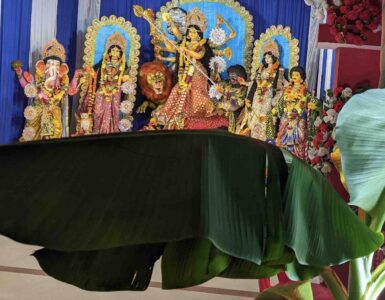
The Navapatrika is then wrapped in a red-bordered white sari and adorned with vermilion, turmeric, and flowers. She is carried in a ceremonial procession and placed beside the idol of Durga, typically on the right side of Lord Ganesha.
In this position, she is lovingly referred to as Kolabou, a symbolic bride, sometimes seen as Ganesha’s consort, sometimes as Durga herself.
The nine plants that comprise the Navapatrika are not chosen randomly; each holds deep spiritual significance and represents a distinct form or aspect of the goddess.
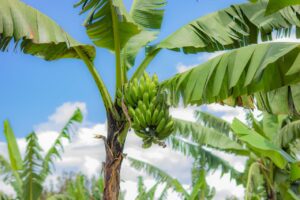
Banana Plant (Goddess Brahmani): Symbolises fertility, abundance, and the nurturing power of the earth.
Turmeric (Goddess Durga): A purifier with healing properties, representing strength and divine energy.
Bel Leaves (Goddess Shiva or Mahalakshmi): Sacred in Hindu rituals, symbolising prosperity and spiritual clarity.
Colocasia/Taro (Goddess Kalika or Aindri): Denotes sustenance and resilience.
Jayanti Plant (Goddess Kartiki): A symbol of victory over evil.
Ashoka Leaves (Goddess Shokarahita): Associated with love and the dispelling of sorrow.
Pomegranate Leaves (Goddess Raktadantika): Represent fertility and the life-force.
Arum Plant (Goddess Chamunda): Linked to wisdom and traditional healing.
Paddy (Goddess Lakshmi or Bhubaneshwari): A vital crop, symbolising nourishment and a sacred bond with the land.
Together, these plants are bound by a yellow sacred thread tied to the Aparajita plant, a symbol of invincibility. By worshipping the Navapatrika, devotees offer their gratitude and reverence toward Mother Nature.
The immersion of the Navapatrika on Dashami, the final ritual, marks the completion of the cycle. Before Durga’s idol is immersed, Kolabou is quietly taken for immersion, often behind a veil to protect her dignity.
This parting ritual, conducted in respectful silence, mirrors the goddess’s symbolic return to the natural world.
Nature, Divine and A Call to Action
Every plant or every ritual gesture during Durga Pujo is a reminder of our ancient bond with the natural world. Yet today, that relationship stands on fragile ground.
As global temperatures rise, the trees and plants across the Indian subcontinent, so central to this festival, are under increasing threat.
Unseasonal rains, intense heatwaves, soil erosion, and erratic weather patterns are already diminishing the vitality of the very flora we revere.
At the same time, the modern scale of Durga Pujo, with its towering pandals, elaborate installations, and temporary infrastructure, often contributes to deforestation and the unsustainable use of natural resources.
If climate change continues unchecked, we risk severing the more profound spiritual connection between Shakti and Prakriti.
Elders in Bengal often say that Durga is not just a goddess; she is Earth, the river in flood and the raging storm. She is both protector and destroyer, mother and warrior.
The trees honoured in her name are her companions, her different forms. As we sing her name and celebrate her return, we must do so with a sense of responsibility.
The significance of Navapatrika extends beyond being a sacred symbol. Let it be a living reminder of the world we must protect if we hope for her blessings to endure.






Add comment