

 changeadmin
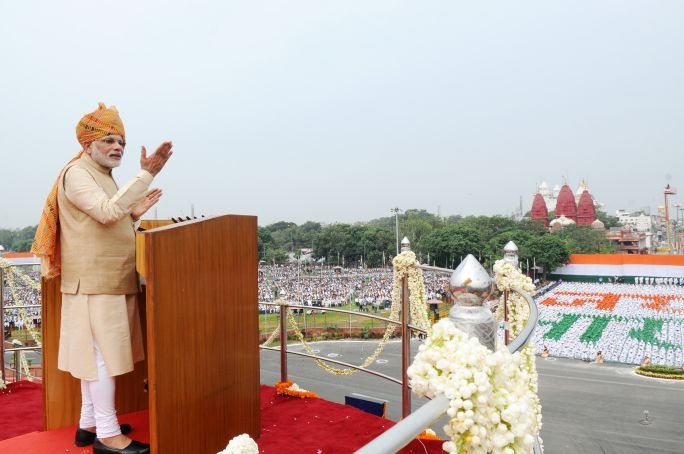
Indian Prime Minister Narendra Modi unfurled the Tricolour and addressed the nation from the ramparts of the majestic Red Fort on the occasion of India’s 74th Independence Day.
The major focus of the speech was overwhelmingly on developing a self-reliant India. In his 90-minute address, which is also his third-longest Independence Day speech, he stressed the need for bringing major reforms for the growth and development of the economy.
He applauded the contributions of corona warriors in fighting the health crisis and India’s armed forces, who are standing against adversaries on the borders.
Apart from that, his 7th Independence Day speech included aspects of the environment, sustainability, and biodiversity.
The development of the Ladakh region as a carbon-neutral
The Prime Minister mentioned that the newly created union territory of Ladakh can become India’s carbon-neutral state. Located in the mountainous region of the Himalayas, the Ladakh region is unique in its diversity and ecology.
Similar to the northeastern state of Sikkim, which has established itself as an organic state, regions of Ladakh, Leh, and Kargil can be developed as a carbon-neutral territory.
That can set a precedent for other regions & states in the country to become carbon-neutral. He mentioned the government plan to develop a 7500 MW solar park in the region.
Renewable Energy
Through the initiative on “One World One Sun One Grid”, India has become a thought leader for the entire world to promote and harness the power of solar energy.
India has become among the top 5 nations in the world in terms of renewable energy.
Pollution
To reduce pollution, India has made remarkable progress in many aspects.
National-level initiatives such as Swachh Bharat, LPG distribution for rural households to ensure smoke-free cooking, promoting LED bulbs for electricity, and focusing on electric mobility have resulted in reducing pollution levels across the country.
India is also leveraging ethanol on a wide scale to reduce dependence on fossil fuels. He mentioned that within 5 years country’s ethanol output has grown by five times to 200 crore litres from 50 crore litres.
He added that the government has identified 100 cities in the country for which an integrated and holistic approach will be followed to reduce pollution.
Bio-diversity

India is one of the few countries in the world where forest cover has increased. The Prime Minister stressed that India is fully committed to improving the biodiversity in the country.
India has successfully taken forward missions like “Project Tiger”, “Project Elephant” for the conservation of wildlife. The projects have resulted in an increase in the number of tigers in the country.
In the near future, the government is planning “Project Lion” for the protection of Asiatic lions. He stressed that all the necessary resources and infrastructure will be provided for its successful implementation.
Another one in the list is “Project Dolphin”, which will focus on river dolphins and sea dolphins. This will not only help in developing biodiversity, but it will also create employment and impetus for the tourism sector.





Add comment